
Introduction
Part One: Revenue Architecture in a Global Context
Beginning at the Edges
I started my career with a ledger and a question. Not the kind you ask auditors or bankers, but the kind you ask when something feels misaligned and the data resists coherence. Why, for instance, do two identical-looking deals, priced the same and signed by similar companies, yield completely different revenue profiles three quarters later? Why does churn sneak in just when our dashboards beam green? Why does the cost of growth vary so wildly between geographies? Those questions, though buried under formulas and fiscal periods, always led me back to the same source: the system’s structure. Over the years, I have come to see global rev ops not as a fixed pipeline or a checklist of functions, but as a dynamic, adaptive organism, one that thrives when guided by revops strategy and informed by revops best practices, fed insight, not just instruction.
I have lived this philosophy across roles that spanned CFO and CRO responsibilities, particularly when managing subsidiary RevOps in North America, Europe, and Asia. From overseeing transfer pricing frameworks and FX hedging mechanisms to co-designing deal desks that operate seamlessly across borders, I have witnessed firsthand how scaling revenue is less about control and more about coordination. What I found again and again was that complexity, if handled poorly, fragments trust and erodes speed. But if designed thoughtfully, it becomes a strategic advantage.
Every time I have taken on a new territory or inherited a regional sales structure, I have walked in with the same toolkit: pattern recognition, statistical curiosity, and a systems mindset shaped by my background in economics, accounting, and data science. I look for asymmetries, not averages. I listen for friction, not just feedback. And I treat the signals from sales, finance, tax, and product as a continuous negotiation: each node offering information, each team interpreting it through its own frame.
The Global Revenue Operations Ecosystem
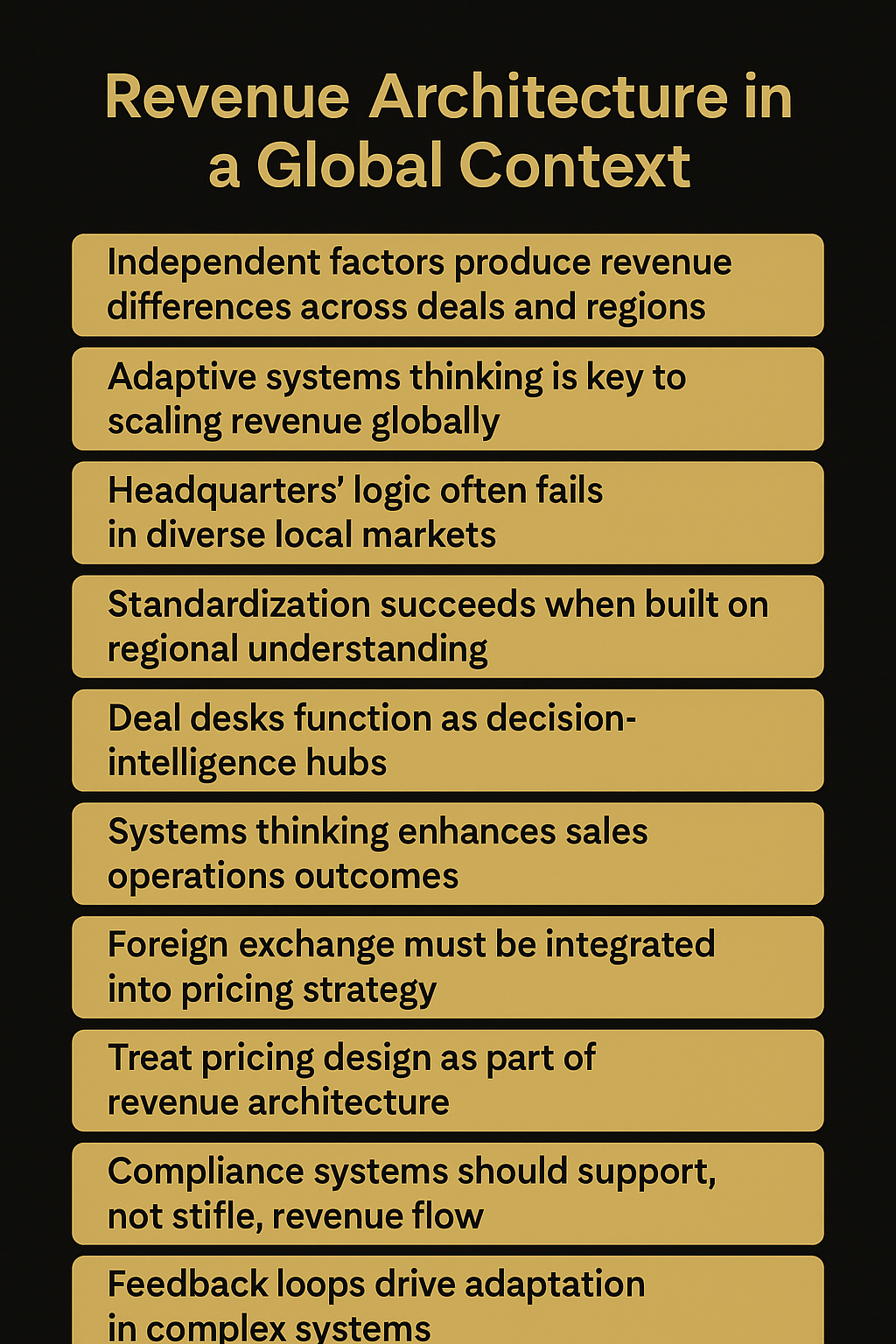
When you oversee revenue operations across continents, the first thing you learn is that the logic of headquarters rarely survives contact with local reality. American sales motions tend to emphasize quarterly cycles; enterprise software buyers in Japan expect more face time and formality; and in Brazil, your invoice must pass through both federal and municipal tax frameworks before revenue recognition becomes real. These are not minor wrinkles; they are structural truths.
I have never believed in forcing uniformity for its own sake. Instead, I have tried to harmonize systems by designing for variation rather than resisting it. This meant configuring CPQ workflows with localized pricing logic, adapting contract templates to reflect not just legal jurisdiction but cultural norms, and embedding VAT/GST rules directly into billing flows. In one initiative, we engineered a revenue-routing matrix that tied product, geography, and delivery method to the appropriate tax treatment and entity-level booking. The system did not just record revenue; it ensured it was real, compliant, and repeatable.
But beyond the mechanics lies something more delicate: trust. In every global team I have led, I have had to earn the right to standardize by first proving that I understood what made each region different. This is especially true when balancing FX exposure. Finance wants currency stability; sales wants pricing agility. The compromise, I found, lay not in splitting the difference but in designing tools that showed the true impact of FX volatility on deal margin: giving sales the context and finance the control.
This philosophy extended into reporting as well. US teams favored net ARR velocity, while European teams focused more on net revenue retention. Rather than argue over metrics, I built a unified dashboard that presented both perspectives with traceable inputs. I did not ask global teams to speak a single language. I built translation layers.
The Adaptive Power of Deal Desk and QTC
Every organization I have worked with underestimated the strategic value of its deal desk until we reimagined it as a decision-intelligence hub. Most companies treat deal desks as compliance checkpoints. I treated them as learning systems. When appropriately designed, a global deal desk does not just accelerate bookings; it teaches the business how to sell better.
We constructed our deal desk engine as a set of conditional rules rather than a static process. If a contract exceeded $500,000 and originated in the EU, it automatically pulled a data privacy addendum based on country-level mandates. If the deal included services in India, it adjusted the tax profile to avoid double taxation under GST. These were not edge cases; they were there every day, and our system learned from each exception. Legal, sales ops, tax, and finance all contributed to a unified clause library. And through analytics, we continuously reviewed where redlines occurred and which pricing exceptions converted most reliably.
We did not try to eliminate exceptions. We made them visible. Every deviation became a learning artifact, not a compliance flag. In one quarterly review, we discovered that deals involving multiple redlines in Latin America had a significantly lower renewal rate in Year Two. That led us to revisit contract clarity, not just post-sale engagement.
Quote-to-Cash, when viewed through this system’s lens, becomes far more than an operational process. It becomes a signal engine. Our QTC design included feedback hooks at each stage: quote generation, legal review, billing setup, and post-sale enablement. If a delay occurred, we did not just fix it. We tagged it, analyzed it, and improved the workflow. We treated QTC not as a linear transaction but as a dynamic loop.
Sales Operations Through a Systems Lens
I have long believed that systems thinking, when applied to sales operations, produces far better outcomes than traditional top-down forecasting models. Sales operations teams tend to optimize for efficiency or compliance. I focused instead on adaptive design.
For example, our sales playbooks did not simply outline features and ICP criteria. They embedded triggers for signal detection, for example, if a rep encountered a specific objection during discovery, that flagged a potential product-market mismatch and initiated a feedback loop to the product. These playbooks evolved not monthly, but continuously, based on field insights surfaced through structured tagging in CRM entries.
In managing regional sales ops, I introduced what we called “momentum metrics”: a layer of leading indicators, including average time in stage, forecast accuracy deltas, and email responsiveness rates. We trained managers to intervene not based on gut instinct, but on measurable signal drift. This allowed us to detect performance issues before they showed up in the booking numbers. We did not just manage pipelines, but we managed learning velocity.
Most importantly, we created alignment mechanisms across geographies. A win in France sparked a weekly sync with the UK team to review pattern overlaps. Our Japan team shared a structured loss review after every major enterprise RFP. These were not postmortems. They were field experiments. And we documented everyone.
GTM Collaboration Between US and Global Teams
Cross-border GTM collaboration often stumbles on two unspoken assumptions: that HQ knows best and that field teams need enablement. Both are wrong. In my experience, global teams frequently innovate faster because they must do more with less. I learned to watch carefully for those innovations and scale them back into the core.
One APAC team, for instance, developed a lightweight, value-first proposal format that dramatically improved time-to-demo. We replicated that across our US commercial segment within weeks. Meanwhile, our European enterprise teams built robust pricing calculators to navigate layered approval structures, which was a tool we soon integrated into Salesforce globally.
To make this possible, I instituted structured collaboration rituals. We held monthly global GTM syncs with rotating region-led presentations. We shared a common scorecard, but allowed each team to choose one locally relevant metric to spotlight. We rewarded not just performance, but knowledge transfer.
Campaigns also became more cohesive. Marketing aligned personas globally, but allowed regional customization of tone, references, and buying behavior. Our playbooks explained not just what to say, but how to listen differently in each market.
Over time, these mechanisms built a culture of mutual respect. US teams stopped assuming they set the standard. Global teams felt seen and heard. And the revenue system spanning sales, ops, finance, and product began to behave less like a set of silos and more like a single, adaptive organism.
Part Two: Intelligence, Pricing, and Feedback in Global RevOps
The Invisible Price of Foreign Exchange
I have managed sales teams in six time zones, each pushing toward similar growth targets under very different financial realities. While most RevOps systems focus on CRM alignment and stage hygiene, real sophistication shows up in what happens after a quote goes out. In multinational deals, pricing is never just a function of value; it is also a function of risk. And that risk has everything to do with foreign exchange.
The American team prices in USD by default. But a customer in South Korea wants to pay in KRW and expects pricing to remain consistent throughout a multi-year contract. If the dollar strengthens 6% in Year Two, who eats the difference? If the local team offers discounts to absorb that, how does that show up in gross margin metrics back at HQ?
I learned not to treat FX exposure as a back-office function. Instead, I embedded real-time FX intelligence into deal design. Our pricing sheets dynamically adjusted for currency trends, and we built rules into our CPQ logic to hedge against margin erosion. Each region received guardrails, not hard stops. This approach allowed local teams to negotiate competitively without undermining our consolidated financial strategy.
We also embedded currency risk into compensation models. A closed deal in Yen no longer received static quota credit. Instead, we weighted attainment by FX-adjusted net revenue. It created better behaviors, improved forecasting accuracy, and most importantly, linked RevOps and finance in a common strategic language. I no longer had to arbitrate between growth and profitability. The system adjudicated that for us with transparency.
Pricing Strategy as Architecture, Not Tactics
For years, I treated pricing strategy as a commercial lever. Today, I treat it as part of revenue architecture. Global pricing cannot function without alignment between sales, legal, finance, tax, and marketing. That truth reveals itself the moment your first localized contract triggers a misclassification on an invoice. It also reveals itself when a campaign offers a discount structure that undermines your approved margin floor in EMEA.
My response has always been structural. I co-developed a pricing design framework that harmonized product configuration, local economic indicators, competitive benchmarking, and strategic margin goals. This framework operated like an adaptive grid. Regional leaders could draw from it like a policy matrix. When launching a bundled offering in Southeast Asia, for example, we used a region-specific elasticity coefficient to define our price anchor and discount thresholds. Finance approved it once. Sales used it dozens of times. The deal desk validated it in real time.
The secret was not in math. It was in the system. We removed friction by embedding policy into infrastructure. Discounts were no longer escalations; they became guided decisions. And because we tracked usage patterns, we refined those parameters each quarter. The system did not just reflect business strategy; it evolved it.
This was especially powerful when paired with partner pricing. In one initiative, we structured a two-tier margin-sharing framework that dynamically adjusted based on deal size, geography, and delivery complexity. Our partners felt empowered, our internal teams felt protected, and the business avoided the common pitfall of channel cannibalization.
From NPS to Revenue Intelligence
For many years, NPS data floated somewhere near the top of executive summaries, which is revered but misunderstood. What I realized, particularly across markets, is that NPS offers little insight unless paired with context and cross-functional data. A score of 6 in Germany does not mean the same thing as a 6 in Australia. Moreover, a shift from 7 to 8 in Japan may signify a dramatic improvement in sentiment, even if it does not move the overall score.
So I stopped asking, “What is our NPS?” and started asking, “What does it predict?” We rebuilt our surveys with a structured taxonomy by capturing not only numeric scores but also thematic metadata. We tagged responses by product module, region, onboarding cohort, and customer size. Then we fed that data into our revenue retention model.
The results were instructive. In North America, detractors were 2.7 times more likely to churn than promoters. In Latin America, the correlation dropped to 1.4x, but early detractor status significantly delayed upsell timelines. In Europe, passives proved riskier than detractors, primarily because detractors engaged with support and success teams while passives drifted quietly. The NPS score itself was not our asset. The segmentation and correlation were.
We used these patterns to build a Customer Health Index that became the foundation of account management prioritization. Sales did not just renew, but they preempted risk. Customer Success did not just react, but they intervened with precision. The system produced loyalty not through sentiment, but through operational visibility.
Building Compliance Without Killing Flow
Global operations introduce complexity that cannot be wished away. Local tax codes, contracting laws, and invoice formats each demand precision. Yet many companies address this complexity with control mechanisms that slow revenue down. My approach has always been different. I ask: How do we build compliance into the flow, not on top of it?
One method I deployed involved real-time rule engines in our deal desk and CPQ platforms. We defined compliance checkpoints —such as VAT treatment, PO requirements, and contract signatures — by jurisdiction. The systems did not require reps to remember these rules. They surfaced requirements contextually. If the deal originated in India, GST fields became mandatory. If the deal exceeded $250K in France, the template switched to local, legally approved terms. The system eliminated ambiguity.
Legal and finance felt more confident. Sales moved faster. And audit risk declined, not because of tighter enforcement, but because of more innovative integration.
This pattern held true in reporting as well. Our global revenue dashboard allowed entity-level views that aligned with statutory reporting formats, while the consolidated view reflected management accounting. We did not force a single structure. We respected multiple truths. This helped us pass audits, but more importantly, it helped the business run faster, not slower.
The Feedback Loop as Strategy
In complex systems, adaptation always beats prediction. That idea, borrowed from my early fascination with information theory and search dynamics, shaped how I approach RevOps design. I no longer ask, “Is our process optimal?” I ask, “Is our system learning?”
That distinction matters. I once led a project where we embedded telemetry into the contract cycle: not just timestamps, but reason codes for redlines, pricing escalations, and legal substitutions. We correlated those patterns with close rates, cycle time, and future churn. The results were precise: deals that redlined three or more times had a 40% higher risk of churn within the first 12 months. More importantly, they closed 18% slower on average.
We used that data to redesign both templates and training. Legal simplified fallback clauses. Sales was coached to pre-frame risk points earlier in the cycle. Our close rates improved. But the real win was the system: it did not just deliver data; it produced feedback.
We applied this thinking everywhere. Our onboarding process had a parallel signal loop. Our billing systems tracked dispute reasons and fed them back to quoting logic. Our CSAT scores triggered product feedback that shaped our roadmap. Each node informed the other. Over time, the organization developed a rhythm of reflection and adjustment that became embedded in how we operated.
This is where operational maturity meets resilience. A high-functioning revenue organization does not avoid complexity; instead, it metabolizes it. And the CRO, alongside the CFO and sales leadership, becomes the choreographer of this loop.
Closing the Loop: From Fragmentation to Flow
Looking back, the challenge of global revenue operations has never been about scale. It has been about cohesion. As soon as multiple geographies, systems, and regulatory frameworks come into play, entropy accelerates. Communication fragments. Process drifts. Intent becomes diluted.
Yet I have learned that coherence is possible, not through control but through structure, not by eliminating variance, but by designing for it. I have seen firsthand how organizations thrive when systems are designed to listen, to learn, and to adapt.
That has been my work. I have harmonized pricing structures across jurisdictions. I have embedded tax compliance into QTC workflows. I have designed deal desks that both protect margin and empower field reps. I have taken NPS from a fuzzy metric to a sharp predictive tool. I have translated the language of global operations into a choreography of signal, strategy, and structure.
And through it all, I have held to one principle: complexity is not the enemy of revenue. It is its most honest teacher. The systems that learn from it intelligently, incrementally, and globally will not only grow but also endure.
Hindol Datta is a CPA, CMA, CIA, and MBA with over 25 years of progressive finance leadership experience across cybersecurity, software, SaaS, and global operations. He currently serves as VP of Finance and Analytics at BeyondID and is pursuing his MS in Analytics at Georgia Institute of Technology.