
Introduction
Navigating the AI Hype Cycle: When to Build or Wait
By Hindol Datta/ July 12, 2025
Dissects the boom-bust pattern of emerging
tech adoption, giving actionable guidance on when to build, partner, or wait.
Part I: The Mirage and the Momentum
The AI economy is moving at a clip that tempts every CEO, CFO, and founder to pick a lane today. If you act too early, you buy shelfware and burn cash. If you wait too long, you miss the compounding effects of data, workflow redesign, and operating leverage. This is the classic innovation dilemma, now amplified by the current AI hype cycle. For leaders focused on building a future proof business, decisions about toolsfrom AI recruiting software and AI recruitment software to AI hiring software are no longer tactical but strategic, shaping how organizations attract talent and sustain advantage in the age of intelligent automation.
First, generative AI usage is no longer niche. In McKinsey’s global survey, 65 percent of organizations reported regular gen-AI use by mid-2024, nearly double the prior year, which confirms broad experimentation and early value capture in the enterprise. McKinsey & Company+1
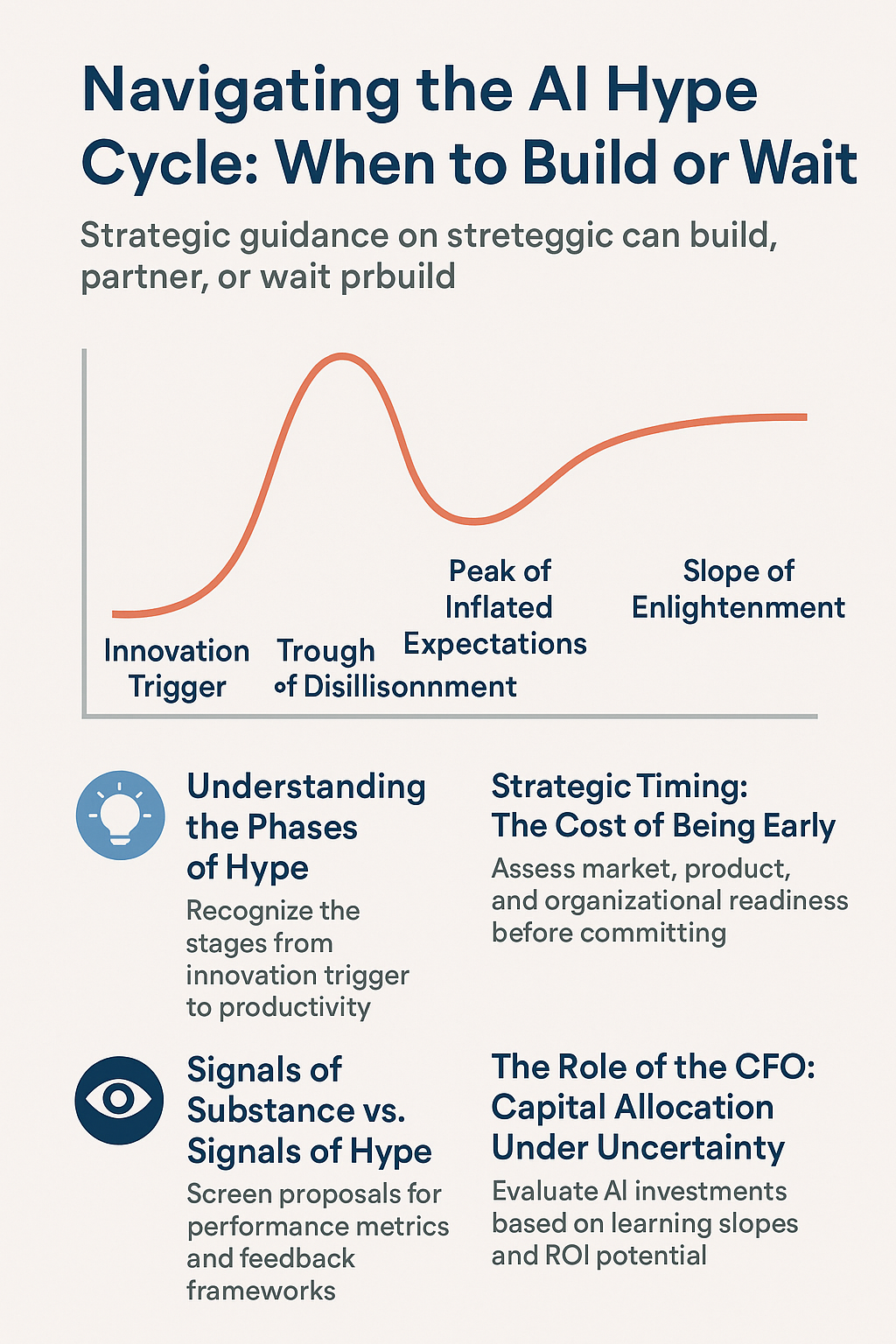
Second, corporate AI investment surged again in 2024, with total spend around 252 billion dollars and private investment up more than 40 percent, indicating sustained capital behind the trend rather than a one-quarter fad. IBM+1 Third, on the hype cycle itself, industry trackers place generative AI just past the Peak of Inflated Expectations, which means visibility is high, pressure is high, and disillusionment risk is rising for teams without strong use-case discipline. Pasqal
Boards are also signaling a shift from curiosity to control. Regulators have begun policing “AI washing,” with the U.S. SEC fining advisers for misleading AI claims and warning issuers about exaggerated AI narratives. That matters for public companies, fundraising decks, and risk disclosures. SEC+2Reuters+2 Meanwhile, compliance windows are opening and closing at different speeds across regions. The EU AI Act entered into force in August 2024 with phased obligations through 2026 and 2027, including earlier timelines for prohibitions and general-purpose model transparency. Translation: market timing now includes compliance timing. Digital Strategy+2European Parliament+2
Put simply, we are in a phase defined by elevated expectations, expanding pilots, real money in motion, and rising scrutiny. In my experience across finance, analytics, and operations, that cocktail demands pacing. The winners do not buy everything. They build learning systems where the unit of investment is insight per dollar, not demos per quarter.
Understanding the Phases of Hype
Gartner’s hype cycle outlines five moods that executives can recognize in the wild: an innovation trigger, an expectations peak, a trough of disillusionment, a slope of enlightenment, and a plateau of productivity. In practice, these phases overlap. Procurement hears the peak. Engineering inherits the trough. Finance finds the truth as run-rate costs and support tickets surface. Today’s generative AI market shows hallmark peak symptoms: pilots greenlit faster than integration plans, agents inserted into workflows without decision-rights redesign, and adoption targets set before data quality, audit trails, and security are ready. Pasqal
A Personal Calibration
Across analytics, cloud, and BI waves, I have seen the same arc. Dashboards arrived before metric governance. Machine learning arrived before drift monitoring. The pattern repeats with agents. Tools are not the problem. Timing and design are the problem. Deploy AI before you understand how it learns, and results regress to the mean. Insert agents before you rewire handoffs, and they mirror your silos.
Strategic Timing: The Cost of Being Early
Being “first” is not always an edge. In AI it can be a tax: fast-changing model behavior, vendor lock-in, and compliance uncertainty. Use three gates before committing material capital:
- Market readiness. Is the customer problem budgeted and urgent.
- Product readiness. Can you deliver reliable, testable outputs with clear error bars and feedback loops.
- Org readiness. Do you have governance, security, and retraining cadence.
If any answer is no, partner first or run bounded pilots. Let your partners amortize platform and compliance risk while you accrue learning.
Signals of Substance vs. Signals of Hype
Executives can screen proposals quickly.
Substance: performance thresholds, data lineage, feedback loops, privacy posture, and measurable business KPIs. Hype: tool names without training data provenance, press headlines outpacing pilot outcomes, and roadmaps that list features instead of learning goals. McKinsey & Company
The Role of the CFO: Capital Allocation Under Uncertainty
Treat AI as an asset class with its own hurdle rates. Score investments on time-to-feedback, override rate, data leverage, and elastic scalability without linear headcount. Tie budgets to the slope of learning, not feature counts. When the SEC is policing narratives, discipline in disclosures and ROI language is not just prudent. It is risk management. SEC+1
Part I Closing Thoughts
Leadership in a hype cycle is about time-boxing uncertainty, paying for compounding learning, and refusing theater. Build what you can refine. Partner for infrastructure. Wait when compliance or data quality lags.
Part II: From Deployment to Discipline
The honeymoon ends when pilots hit the P&L. Latency, model drift, prompt churn, retraining overhead, and user retraining appear as real costs. At this stage, reframe AI from cost cutter to learning engine. The metric is no longer outputs produced. It is error reduced, intervention avoided, and decision speed improved.
The Post-Hype Drop: Recalibrating Expectations
If variance narratives still wobble and agents still need heavy supervision, hire to raise learning velocity. You need finance analysts who can prompt well, controllers who understand audit trails for synthetic outputs, product managers who own model retraining cadence. Treat the program as operations, not a lab.
AI Is Not a Cost Saver. It Is a Compounding System
Cost saves plateau. Learning compounds. Track override rate, decision latency, and delta in forecast error with and without agents. When those curves improve quarter on quarter, the AI stack is becoming a value center. If they stall, refactor or retire the use case.
Build the Operating Layer
Agents fail when the middle layer is missing. You need an orchestration tier that mediates access to ERP, CRM, contracts, and data lakes, along with a governed semantic layer for context. That reduces hallucination risk, shortens cycle time, and supports auditability that boards and regulators will expect as rules harden. Digital Strategy
Metrics That Matter
Move beyond token and query counts. Measure agent-accelerated decisions per week, human override rates, contract cycle time, and forecast deviation improvements. These are the board-grade numbers that justify capital.
When to Pause, Pivot, or Sunset
Pause if learning signals are improving but feedback loops are inconsistent. Pivot if you scoped the problem poorly. Sunset if error and overhead exceed value. Treat each deployment as a hypothesis, not a marriage.
Partnering vs. Building Again
As markets mature, re-audit. If vendors now provide better governance APIs and regional controls, partner. If your data edge grew and you can align models tightly to internal rules, build. Avoid sunk-cost bias.
A Word on Burn
Model fine-tuning, retraining, prompt library maintenance, and incident response are real costs. Make them visible. Forecast them. Manage them as part of your AI cost stack.
Closing Thought
Discipline is not anti-innovation. It is the precondition for durable ROI.
Part III: Compounding Through Intelligence
The final objective is not to deploy AI. It is to build a business that learns faster than competitors. That is how you convert hype beta into strategic alpha.
AI as an Asset, Not a Tool
Record knowledge accumulation rate, organizational dependency on AI-augmented decisions, and attribution between agent recommendations and outcome improvements. The 2025 AI Index shows capital intensity rising. Treat your AI systems like amortizable intellectual capital. They must be trained, governed, and refreshed to earn their place. IBM
From Linear Workflows to Nonlinear Agents
Embrace nonlinearity. In revenue, let agents generate counterfactuals and experiment paths. In procurement, balance price, delivery risk, and vendor concentration with multi-objective recommendations. In FP&A, simulate stress and elasticity rather than arguing point estimates.
Architect the Intelligence Stack
Build a clean semantic layer, a feedback infrastructure, and lineage from data to model to decision. These are prerequisites for explainability and compliance, especially as the EU AI Act timelines stagger into force and U.S. enforcement intensifies around claims and controls. Digital Strategy+1
Talent Strategy
Most value now comes from AI-adjacent roles: prompt-literate analysts, data stewards, learning engineers, and agent supervisors. Incentivize reduction in overrides and measurable gains in decision speed.
Board Oversight
Add AI to audit and risk agendas. Ask where agents shape outcomes today, what explainability exists, how overrides are logged, and how regional compliance is being met as transparency and high-risk system rules phase in. European Parliament
Compounding Intelligence
Your moat is the slope of learning. Shorter feedback loops, fine-tuning to proprietary signals, and users as co-teachers become defensibility. That is how you earn sustainable enterprise AI ROI, not just initial headlines.
Final Word: Build with Conviction, Govern with Clarity
The hype will continue. New models, bigger benchmarks, louder marketing. Your job is to convert noise into knowledge. Build where you can refine. Partner where infrastructure and compliance are non-trivial. Wait when the inputs are ready. Above all, design for learning and auditability.
For CFOs and boards, this is capital stewardship in an AI hype cycle: invest in systems that get smarter every week, report in language the market trusts, and operate within the guardrails regulators are clearly erecting. That is how you compound advantage when everyone else is chasing the peak. Digital Strategy+3Pasqal+3McKinsey & Company+3
Hindol Datta, CPA, CMA, CIA, brings 25+ years of progressive financial leadership across cybersecurity, SaaS, digital marketing, and manufacturing. Currently VP of Finance at BeyondID, he holds advanced certifications in accounting, data analytics (Georgia Tech), and operations management, with experience implementing revenue operations across global teams and managing over $150M in M&A transactions.