
Introduction
Navigating Tax Risks in M&A Deals: A CFO’s Insight
Mergers and acquisitions are not closed by vision alone. They are closed in data rooms, diligence checklists, and Excel models buried beneath layers of assumptions. In the complex world of M&A, even the most minor oversight can create ripples that derail momentum. As a CFO who has supported venture-backed companies through Series A to D growth, I have seen promising deals falter not because of market shifts or valuation gaps, but because of poorly managed tax positions. Understanding M&A tax risks and clearly explaining them to all stakeholders can be the difference between a seamless close and a deal that unravels under scrutiny. Deferred tax exposures are items that seemed innocuous in the early years but resurface with serious consequences when M&A activity accelerates.
Over my career, I have partnered with founders, investors, and tax practitioners in the Bay Area to prepare companies for these critical junctures. While I often engage second-tier tax firms, I deliberately choose those with deep expertise in state, federal, and international compliance. These advisors may not have Big Four branding, but they deliver practical insights that are both cost-effective and battle-tested. In M&A deals, this balance of cost and expertise becomes a competitive advantage.
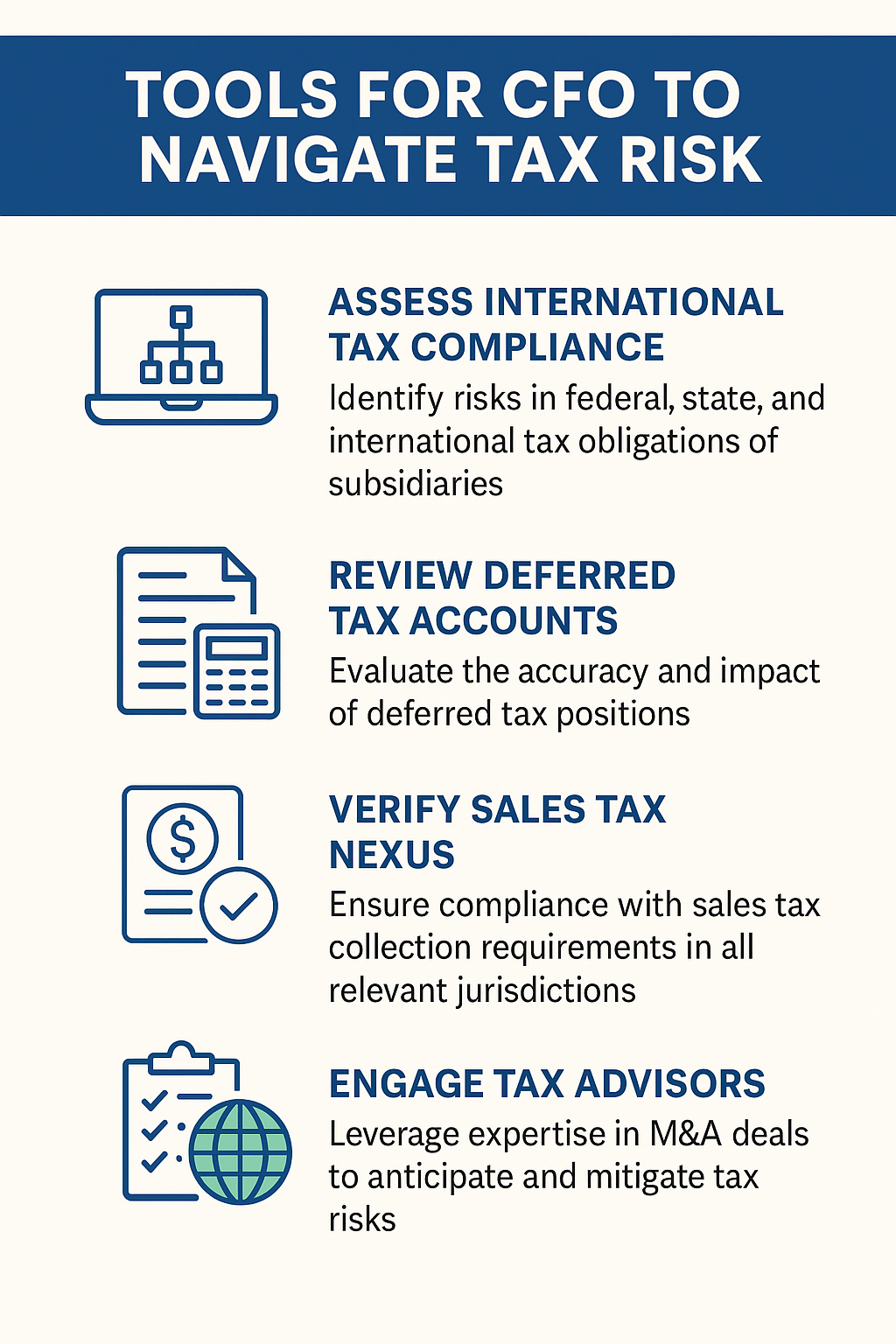
Here is a tool that you might find helpful, but I would highly recommend you take the time to read this entire article.
Tax Considerations Are Deal Makers or Deal Breakers
Many founders underestimate how deeply tax compliance influences acquisition strategy. They focus on valuation optics, strategic fit, and customer overlap. Yet tax, when neglected, becomes the silent veto. It is the unspoken reason behind extended diligence cycles, price reductions, escrow holds, and sometimes outright abandonment.
Buyers do not just buy revenue streams. They buy confidence. Confidence comes from clean books, accurate tax filings, and transparency across deferred tax positions, net operating losses, sales tax obligations, and employee equity. I have seen entire boards stunned when the acquisition price was reduced because deferred tax assets were overstated or sales tax nexus had been ignored.
This essay outlines how executives can preempt tax surprises that threaten deal viability. It draws on real-world transactions, explains the most overlooked exposures, and shows how CFO-level decision-making, supported by experienced tax advisors, reduces risk while preserving deal value.
Deferred Taxes Are Not Just Accounting Entries
In financial statements, deferred taxes often appear as abstract numbers. But in transactions, they transform from theoretical to tangible liabilities. Buyers scrutinize deferred tax positions to evaluate cash flow impact. If calculations are inaccurate or unsupported, they demand adjustments.
Startups that fail to reconcile depreciation schedules, R&D capitalization policies, or revenue deferral methods often carry deferred balances that appear correct on paper but collapse under due diligence. Acquirers dig into ledgers, expense recognition, and differences between GAAP and IRS treatment. When discrepancies emerge, trust erodes, and trust is the currency of M&A readiness.
I supported a transaction where sellers overstated deferred tax assets tied to net operating losses. Under Section 382 limitations, most of those NOLs were unusable. The buyer cut the purchase price by 7%. That knowledge gap costs not just capital but negotiating power.
Deferred tax diligence is not ceremonial. It is forensic. Companies that prepare years in advance strengthen their financial strategy and increase investor confidence.
Sales Tax Compliance: The Most Commonly Overlooked Risk
Among all tax exposures, sales tax is the most common and the most avoided. In SaaS, ecommerce, and services, state-by-state rules make sales tax compliance a minefield. Nexus is the threshold that creates an obligation to collect and remit taxes, and can be triggered by a remote employee, a digital download, or even a marketing activity.
The 2018 Wayfair decision gave states broad power to impose economic nexus, even without physical presence. Many startups register in one state while operating nationally. This oversight, Mergers and acquisitions are not closed by vision alone. They are closed in data rooms, diligence checklists, and Excel models buried beneath layers of assumptions. In the complex world of M&A, even the most minor oversight can create ripples that derail momentum. As a CFO who has supported venture-backed companies through Series A to D growth, I have seen promising deals falter not because of market shifts or valuation gaps, but because of poorly managed tax positions. Understanding M&A tax risks and clearly explaining them to all stakeholders can be the difference between a seamless close and a deal that unravels under scrutiny. Deferred tax exposures are items that seemed innocuous in the early years but resurface with serious consequences when M&A activity accelerates.
Over my career, I have partnered with founders, investors, and tax practitioners in the Bay Area to prepare companies for these critical junctures. While I often engage second-tier tax firms, I deliberately choose those with deep expertise in state, federal, and international compliance. These advisors may not have Big Four branding, but they deliver practical insights that are both cost-effective and battle-tested. In M&A deals, this balance of cost and expertise becomes a competitive advantage.
Tax Considerations Are Deal Makers or Deal Breakers
Many founders underestimate how deeply tax compliance influences acquisition strategy. They focus on valuation optics, strategic fit, and customer overlap. Yet tax, when neglected, becomes the silent veto. It is the unspoken reason behind extended diligence cycles, price reductions, escrow holds, and sometimes outright abandonment.
Buyers do not just buy revenue streams. They buy confidence. Confidence comes from clean books, accurate tax filings, and transparency across deferred tax positions, net operating losses, sales tax obligations, and employee equity. I have seen entire boards stunned when the acquisition price was reduced because deferred tax assets were overstated or sales tax nexus had been ignored.
This essay outlines how executives can preempt tax surprises that threaten deal viability. It draws on real-world transactions, explains the most overlooked exposures, and shows how CFO-level decision-making, supported by experienced tax advisors, reduces risk while preserving deal value.
Deferred Taxes Are Not Just Accounting Entries
In financial statements, deferred taxes often appear as abstract numbers. But in transactions, they transform from theoretical to tangible liabilities. Buyers scrutinize deferred tax positions to evaluate cash flow impact. If calculations are inaccurate or unsupported, they demand adjustments.
Startups that fail to reconcile depreciation schedules, R&D capitalization policies, or revenue deferral methods often carry deferred balances that appear correct on paper but collapse under due diligence. Acquirers dig into ledgers, expense recognition, and differences between GAAP and IRS treatment. When discrepancies emerge, trust erodes, and trust is the currency of M&A readiness.
I supported a transaction where sellers overstated deferred tax assets tied to net operating losses. Under Section 382 limitations, most of those NOLs were unusable. The buyer cut the purchase price by 7%. That knowledge gap costs not just capital but negotiating power.
Deferred tax diligence is not ceremonial. It is forensic. Companies that prepare years in advance strengthen financial strategy and increase investor confidence.
Hindol Datta, CPA, CMA, CIA, brings 25+ years of progressive financial leadership across cybersecurity, SaaS, digital marketing, and manufacturing. Currently VP of Finance at BeyondID, he holds advanced certifications in accounting, data analytics (Georgia Tech), and operations management, with experience implementing revenue operations across global teams and managing over $150M in M&A transactions.