
Introduction
Trust Begins Where Transparency Meets Context
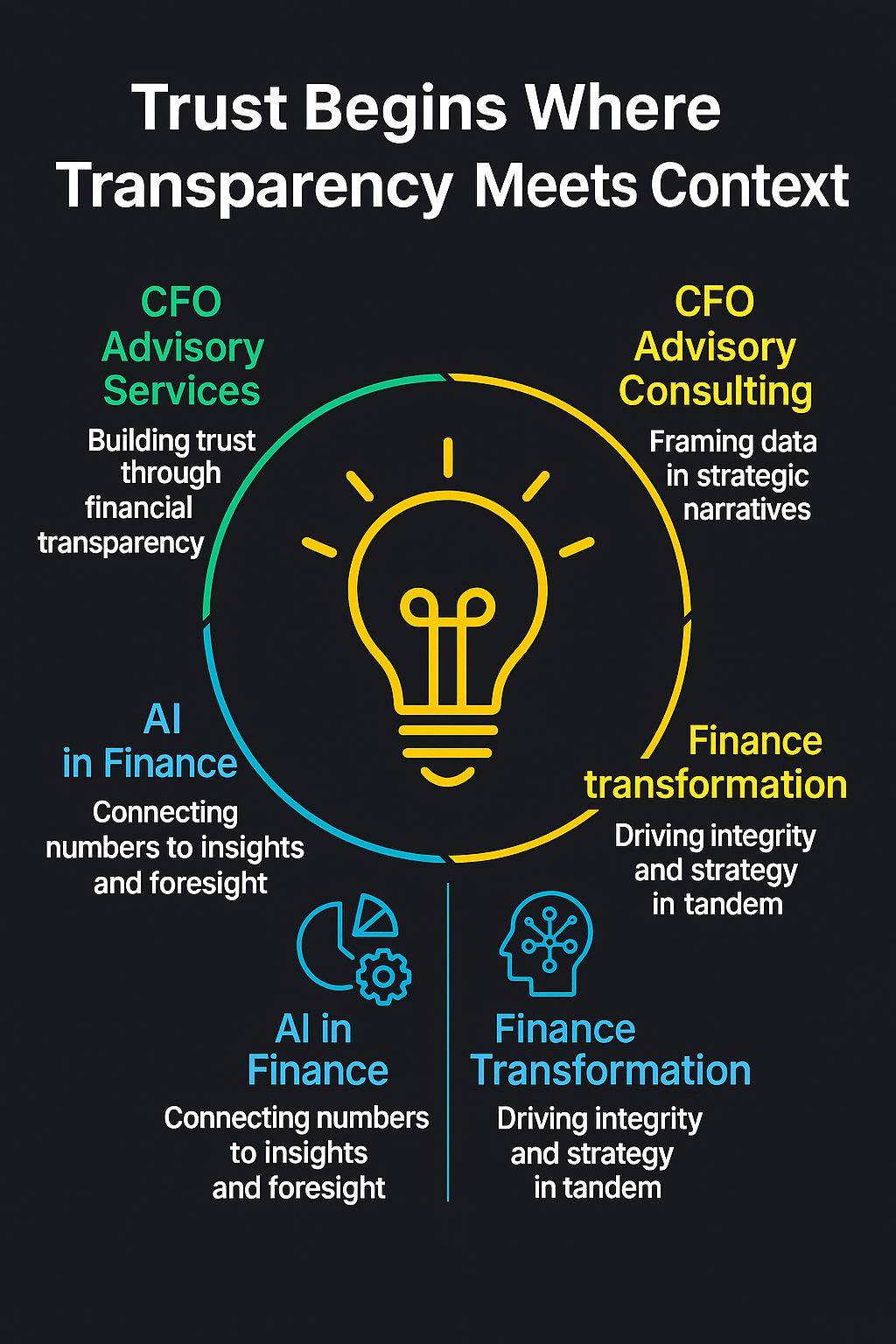
I did not begin my journey in finance to become a mere steward of compliance. Like many in this field, I started with spreadsheets and statements, GAAP checklists and audit cycles. Over time, however, it became uncomfortably clear that the most profound questions coming from the boardroom had nothing to do with technical accounting. They were concerned about clarity. They demanded a narrative. They asked not just “What happened?” but “Why did it happen?” and “What does it mean for our future?” This is where CFO advisory services step in, moving beyond traditional reporting into strategic storytelling. Through CFO advisory, CFO advisory consulting, and the integration of AI in finance, the role of the finance leader expands from compliance guardian to forward-looking strategist driving financial transparency, CFO drive, and CFO strategies while leveraging expertise in finance transformation strategy consulting and financial transformation services.
In my experience across three decades and a variety of company growth stages, from seedling startups to Series D scaling challenges, the most effective CFOs do not simply interpret the past. They provide a frame for decision-making. They marry accounting integrity with strategic foresight. They become, in effect, a translator between what the numbers show and what the business must do next. And they do so by investing in the most undervalued financial asset of all: trust.
Revenue Operations: Where the CFO Touches the Frontline
During my first month as CFO at Lifestyle Solutions, I discovered something that my MBA from Cal State East Bay and my CPA training never taught me: revenue operations is not a back-office function you can delegate and forget. It is the nervous system of your entire business, and if you are not personally wired into it, you are flying blind.
I learned this the hard way while managing our global logistics operations across three continents. We were scaling rapidly, but our quote-to-cash cycle was breaking down faster than we could patch it. Deals were getting stuck in legal reviews for weeks. Our CRM system showed a pipeline that did not match reality. Sales reps were creating workarounds that bypassed our pricing controls entirely.
The temptation was to blame sales execution, but my systems thinking background told me to look deeper. During my analytics training at Georgia Tech and my years implementing ERP systems from NetSuite to Oracle Financials, I had learned that symptoms usually point to structural problems, not people problems. Our revenue operations challenges were not about incompetent salespeople. They were about systemic friction points that we had unknowingly built into our processes.
At Adteractive, where I watched us grow from 11 to 270 employees while revenue exploded from $9M to $180M, I discovered that revenue operations success depends on real-time collaboration between finance, systems, and commercial teams. You cannot sit in your controller’s office reviewing deals after they close. You have to be embedded in the process as it unfolds, like a navigator calling out hazards during a race rather than analyzing the crash afterward.
My Project Management Professional certification taught me that complex processes fail at their integration points, not their individual components. When I started personally attending deal desk reviews, where I led commercial contracts for our product solutions, I could see exactly where our quote-to-cash process was breaking down. A three-department pricing approval process was not just inefficient; it was also cumbersome. It was a symptom that we did not trust our own pricing framework.
This connects directly to my complexity theory research, which I have explored extensively in my writings on complex adaptive systems. As I noted in my analysis of internal versus external complexity, systems work best when they balance structure with adaptability. Revenue operations management is precisely this kind of complex adaptive system. It needs enough governance to prevent chaos but enough flexibility to respond quickly to market opportunities.
The solution came from applying Six Sigma principles I had learned during my manufacturing days combined with the business intelligence frameworks I had implemented at companies like Atari, where we deployed MicroStrategy for global sales and distribution analytics. We redesigned our deal desk process around exception management rather than approval bottlenecks.
Instead of requiring multiple sign-offs for every non-standard deal, we created intelligent automation that flagged only the deals that truly warranted human intervention. Pricing within established bands was automatically applied. Customer fit scores, calculated from post-sale performance data, helped sales reps understand which concessions actually improved long-term value versus those that just delayed inevitable churn.
My experience managing over 14 audits across international and local jurisdictions taught me that the best governance feels invisible when it is working correctly. Financial controls should function like the rails under a high-speed train. You know they are there because the train moves smoothly and safely, but passengers never feel constrained by them.
This philosophy proved essential when I was implementing shared service centers across distributed teams in India, Ukraine, Sri Lanka, France, and the UK. Revenue operations cannot feel like corporate bureaucracy imposed from headquarters. It has to feel like infrastructure that enables local teams to move faster and close better deals.
After twenty-five years of managing finance operations across cybersecurity, gaming, logistics, and education sectors, I have learned that CFOs who treat revenue operations as someone else’s problem are missing their most important feedback loop. The quote-to-cash cycle tells you everything you need to know about whether your strategy is actually working or just working on paper.
Trust in revenue operations gets built upstream through transparent processes, not downstream through post-mortem analysis. When sales teams understand the logic behind pricing policies and finance teams understand the reality of competitive dynamics, the whole system starts working like the complex adaptive system it was meant to be.
The Deal Desk as a Decision Factory
The deal desk is often mistaken for a bottleneck. In truth, it is one of the most powerful arenas for building institutional memory. I have seen organizations that operate with tribal wisdom and one-off approvals, Slack messages that double as policy, and Excel sheets that die with departing employees. Such companies burn trust like a poorly tuned engine burns fuel. By contrast, when finance partners with sales and legal to institutionalize a standard playbook —defining terms, escalation paths, pricing logic, and risk thresholds —the deal desk becomes a decision factory. It scales judgment. It builds signal integrity.
Here, context becomes crucial. I once encountered a Series C company with an enviable pipeline and a chaotic booking process. Deals sat idle in limbo between “committed” and “approved.” Sales reps negotiated terms beyond their mandate. Legal could not keep up. Revenue recognition suffered. We stepped in not to point fingers but to build structure. We implemented a centralized deal desk dashboard, linked it to Salesforce, and introduced pre-approved templates with embedded legal clauses. Within two quarters, deal velocity improved by thirty percent, and our close rates stabilized. But most importantly, the board began to trust our revenue forecasts, not because the numbers changed, but because the process behind them gained credibility.
Financial Systems: Trust Built Through Design, Not Afterthought
I learned early that you cannot bolt on trust. You must architect it. This principle holds not just in culture, but in systems. Too many firms treat their ERP or billing platform as a necessary evil. They aim for compliance rather than intelligence. But systems are not just for accountants. They are the lungs of a business. They move data, make decisions, and provide early warnings when something is structurally misaligned.
In one case, we deployed a unified QTC stack combining CPQ, contract lifecycle management, and automated billing. The outcome was not only faster cash realization but also a dramatic reduction in quarter-end chaos. When the system works, it frees up executive cognitive load to think, not chase numbers. It empowers sales teams to trust that what they promise will be operationally feasible. It assures the board that commitments made are commitments kept.
Search Theory and the Art of Choosing What to Pursue
I often borrow from search theory when explaining revenue strategy to colleagues. In environments filled with uncertainty, we are not simply forecasting outcomes; we are choosing how long to search before committing to a course of action. Every deal cycle, every pricing decision, is essentially an optimization between time, risk, and opportunity. The deal desk, properly framed, becomes an application of optimal stopping theory. When do we say yes to a marginal customer? When do we hold out for higher value?
This lens changed how I viewed discounting strategies. Rather than chasing conversion at all costs, we began analyzing win-loss data against discount bands. We realized that below a certain threshold, discounting did not materially increase win rates. It just signaled desperation. So we restructured our incentives, gave reps visibility into discount elasticity curves, and framed each deal as a search problem: are we overpaying for this customer’s signature?
The Boardroom Needs More Than Numbers
One of the most enduring misconceptions about the CFO role is that it exists to present the cleanest version of the truth. I have never believed in sanitizing data. But clarity requires more than charts. It requires narrative. I remember a board meeting in which we presented stellar quarter-over-quarter growth, yet saw eyebrows raised. The issue was not performance. It was a lack of context. Investors wanted to understand why growth came from one vertical and not another. They wanted to know whether our QTC improvements had created a sustainable lift or merely smoothed a rough patch.
So, I began framing financial presentations with what I now call the four C’s: clarity, consistency, context, and credibility. Every metric tells a story. But the best financial stories preempt questions rather than trigger them. They acknowledge uncertainty without sounding evasive. They differentiate between volatility and variance. And most importantly, they align with the strategic narrative the CEO is driving.
Information Theory and the Signal Behind the Signal
Working at the intersection of finance and systems, I have developed a deep appreciation for information theory. In particular, the idea that every communication carries a specific entropy, which I reckon is a measure of unpredictability. As CFO, my job is often to reduce entropy. When stakeholders cannot distinguish noise from signal, they lose confidence. This applies as much to internal dashboards as it does to board decks.
In one instance, we found that our forecasting model consistently underperformed not because of flawed logic, but because of fragmented inputs. Sales teams used inconsistent probability definitions. Ops lacked clarity on implementation timeframes. The model, elegant on paper, digested garbage. We created a system of signal hygiene. We trained reps to align on pipeline definitions. We integrated project management tools into our revenue timelines. And we began weighing forecasts not by deal size but by behavioral markers such as customer responsiveness and contract redlining velocity. The model became more accurate. But more importantly, it regained trust.
Why Grit Matters More Than GAAP
At some point in a CFO’s journey, they realize that compliance, while essential, is never enough. GAAP gives us a language. It does not provide us with wisdom. That comes from iteration, from mistakes, from the grit it takes to navigate ambiguity. I have encountered moments when I had to challenge auditors, not to obscure the truth, but to preserve it. I have disagreed with valuation methodologies that lacked industry context. I have defended the operational implications of deferred revenue in growth-stage companies. And in each case, I returned to first principles: what do our stakeholders need to know, and how can we say it clearly?
The real test of grit, I have found, lies not in the audit room but in the strategy room. It comes when the CEO turns to you and says, “Can we afford this risk?” It comes when your team asks whether to expense or capitalize a borderline cost. It comes when you must stand behind a forecast, knowing full well that external conditions may invalidate your assumptions. In those moments, trust is not granted. It is earned.
The Catalyst Role of CFO in Series A to D Companies
Startups in the Series A to D range often straddle two worlds: the chaos of invention and the discipline of scale. Here, the CFO must act as a catalyst and not just a controller. That means activating talent, shaping strategy, and embedding financial literacy into product and commercial teams. It also means translating board expectations into operational priorities. I have often seen founders overwhelmed by financial complexity. They do not need jargon. They need clarity. They need someone who can tell them, in plain language, what the runway looks like, what margins are masking, and which levers can extend growth without cannibalizing focus.
This is where the CFO’s voice becomes strategic. Not louder, but sharper. When we speak with clarity, stakeholders respond with confidence. When we show our work, not just our results, we foster alignment. And when we acknowledge uncertainty while proposing options, we become the kind of leader that teams trust not just to guard the books, but to guide the business.
Clarity Is the New Currency
In today’s environment, which is marked by volatility, investor scrutiny, and pressure for early profitability, the search for clarity has become a form of capital. Boards will forgive missed projections if they believe in your framework. Investors will tolerate pivots if you explain why the old strategy failed and what new evidence supports the new one. But ambiguity drains goodwill. It corrodes morale. It slows decision-making. A CFO who can reduce ambiguity adds tangible value to every leadership discussion.
Which brings us full circle. From GAAP to grit is not a rejection of accounting discipline. It is an evolution. It is the recognition that trust, not spreadsheets, is the true currency of leadership. It is the realization that CFOs must not merely close the books, but open the conversation.
Call to Action: Elevate the Conversation
To my fellow CFOs navigating the complex terrain between operational execution and strategic guidance, I pose this challenge: treat every stakeholder interaction as a trust-building opportunity. Do not wait for the audit to demonstrate rigor. Show it in every deal you approve, every dashboard you publish, and every question you preempt.
To boards and CEOs: demand more from your finance leaders—not just accuracy, but clarity. Ask not only for the numbers but for the thinking behind them. Expect financial storytelling, not just financial reporting.
And to those building companies from Series A onward, remember this: trust does not scale unless it is designed. Build systems that align. Build narratives that explain. And above all, build teams that do not fear the numbers, but understand what they mean.
Hindol Datta is a CPA, CMA, CIA, and MBA with over 25 years of progressive finance leadership experience across cybersecurity, software, SaaS, and global operations. He currently serves as VP of Finance and Analytics at BeyondID and is pursuing his MS in Analytics at Georgia Institute of Technology.